Training
fastcxt uses PyTorch Lightning for distributed training with Beta-NLL loss.
Quick start
# Train base model on preprocessed data
fastcxt-train --model base --dataset-path ./sims/processed --gpus 0

# Multi-GPU training
fastcxt-train --model large --dataset-path ./sims/processed --gpus 0 1 2 3

# With tree features
fastcxt-train --model base_trees --dataset-path ./sims/processed --gpus 0
Model presets
Preset |
d_model |
enc_layers |
dec_layers |
trees |
|---|---|---|---|---|
|
128 |
4 |
2 |
no |
|
256 |
6 |
4 |
no |
|
512 |
8 |
6 |
no |
|
256 |
6 |
4 |
yes |
Training configuration
The TrainingConfig dataclass controls optimizer and scheduler settings:
from fastcxt.config import TrainingConfig

tc = TrainingConfig(
    max_lr=3e-4,
    min_lr=3e-5,
    warmup_iters=100,
    lr_decay_iters=150_000,
    batch_size=128,
    grad_accum_steps=4,
    weight_decay=0.1,
)
Loss function
fastcxt uses Beta-NLL loss (β = 0.5), a stabilized variant of Gaussian negative log-likelihood that prevents variance inflation during early training:
The key insight is that \(\hat\sigma^2\) is detached inside the weighting term, so gradient signal for large-error samples is down-weighted without creating a shortcut for the variance head to simply predict large variance everywhere. The log-variance output is clamped to [-10, 10] for numerical stability.
Validation metrics
During training, the following metrics are tracked:
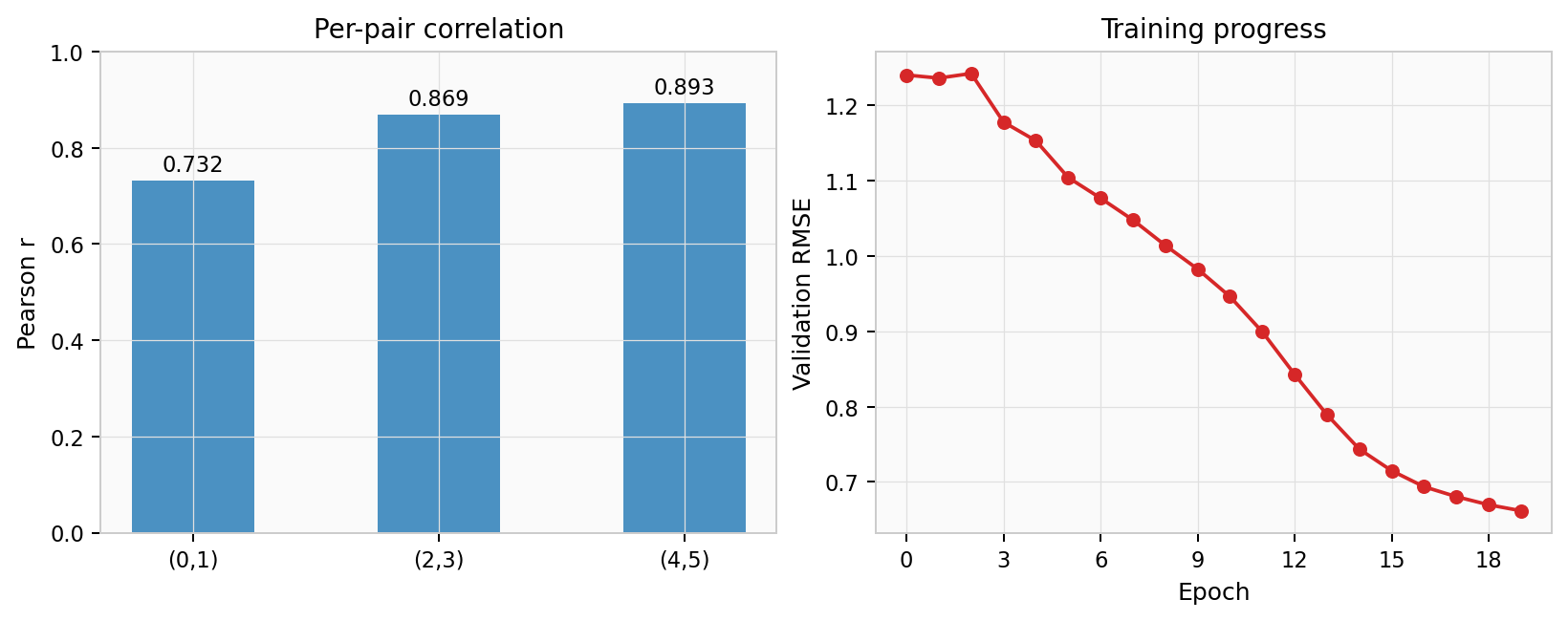
train_loss/val_loss: Beta-NLLtrain_rmse/val_rmse: RMSE of the mean predictionval_coverage_95: fraction of targets within the 95% prediction interval
The figure below shows a typical training curve for the base preset
(20 epochs, 3 GPUs, 1000 simulated tree sequences with variable sample sizes):